

studium oecologicum
Sustainability at TU Dortmund has long been more than just a guiding principle. It shows up in concrete places across campus and spans different areas of action – from teaching to research to operations. Yet many of these places remain invisible: without actively looking for them, it's easy to walk right past. This is exactly where the seminar series "TUWas! – Making Sustainability on Campus Visible" comes in. It raises awareness among students, staff, and visitors of the many dimensions of sustainability, contributing to greater appreciation and further development of TU Dortmund's sustainability efforts.
In the first run of the seminar in the summer semester of 2026, participants worked in small groups to identify sustainable places on campus and worked out their contribution to sustainability. They documented their findings on three information panels aimed at the general public.
In doing so, the seminar series contributes to the Whole-Institution Approach: following this approach, sustainability is not only taught but embedded across all areas of the university – in teaching, research, operations, and administration alike (Helling 2025).
The texts produced in the seminar are collected on this page. A further seminar will take place in the winter semester of 2026/2027, so that a growing overview of sustainable places on campus will emerge over the long term.
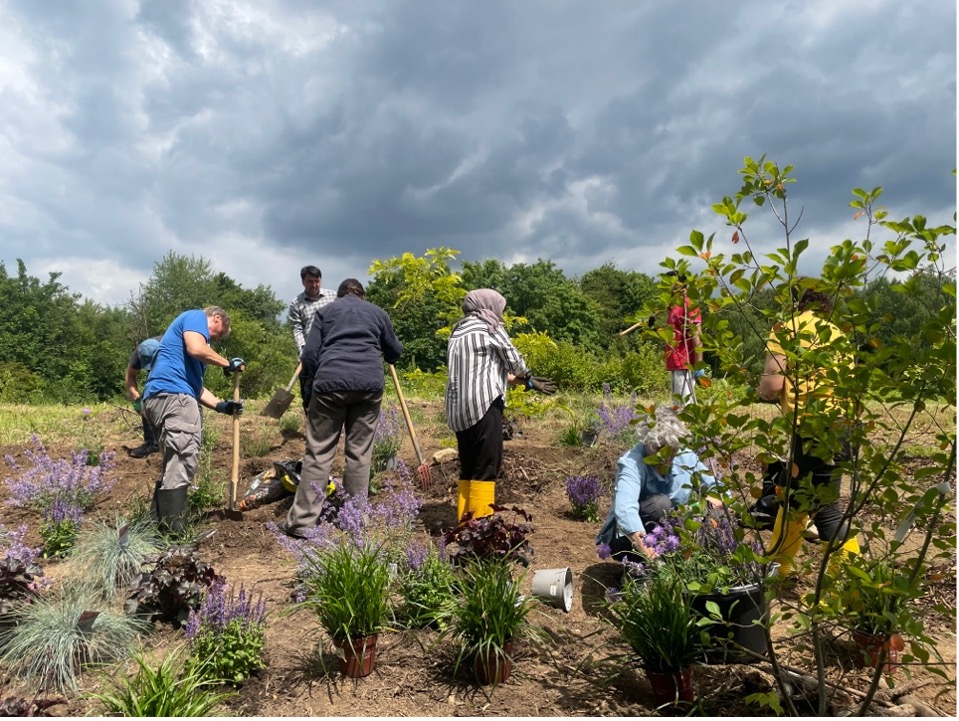
A mini-forest as a place of refuge, dialogue, environmental research, and academic freedom.
Located near the “Internationales Begegnungszentrum” (IBZ) on TU Dortmund’s North Campus, the "Garden(s) of Refuge" is a project initiated by the Academy in Exile (AiE). The project represents a collaborative effort between applied degree programs, the AiE, and the Hokido daycare center (Heetpaß 2026). By bridging the human rights advocacy of the AiE with spatial planning research from "Smart Urban Areas", the initiative supports scholars who face persecution due to their research activities or civil society engagement (Academy in Exile n.d.).
The garden, managed under the direction of Prof. Dr. Agnew, is classified as a micro-forest or "Tiny Forest." Its design follows the Miyawaki method, utilizing a wide range of native species (Academy in Exile n.d.). A defining feature of this methodology is its high planting density, placing three to five plants per square meter instead of the conventional single plant (Heetpaß 2026). When combined with targeted soil restoration, this dense cultivation allows a mature ecosystem to develop within just a few decades (Lewis, Hawken 2022: 11f.). The site itself, which was previously covered in construction debris, was first cleared and prepared in 2024 (Mein Garten 2026, Academy in Exile n.d.). Following an initial phase in November 2025 where nearly 1,000 trees and shrubs were planted, the site was expanded in March 2026 with an additional 350 plants (Mein Garten 2026). Now fully planted, the micro-forest requires about three years of maintenance before it can grow independently as a climate-resilient ecosystem (Heetpaß 2026). After this initial care phase, the densely wooded area will become completely self-regulating, transforming over the long term into a small, ecologically valuable forest. Beyond biological benefits such as high carbon sequestration, the project strengthens social cohesion by actively engaging the local community across all generations in the planting process (Lewis, Hawken 2022: 11f.).
The garden is also designed to serve as a hub for teaching, research, and education (Academy in Exile n.d.). A primary research focus centers on comparing the Miyawaki method against traditional cultivation techniques (Heetpaß 2026). Additionally, researchers plan to map the garden's acoustic environment using specialized measuring equipment (Academy in Exile n.d.). Because the Hokido daycare center directly adjoins the site, local children can actively experience the space, fostering an early connection to forestry and nature (Heetpaß 2026).
Furthermore, the integrated "Oral History" project highlights key aspects of social sustainability within the garden context. This initiative shares the personal stories of AiE members through QR codes attached directly to individual trees. In contrast to the rest of the micro-forest, these specific trees are not native; instead, they were selected from the home countries of the members (Heetpaß 2026). These recorded narratives form part of the "What Grew at Home" exhibition, which provides a space for participants to engage deeply with the flora of their respective homelands (ibid.).
The project extends beyond its physical boundaries into the digital realm. Using drone photography and geospatial data, the garden has been meticulously recreated as a digital twin within the video game "Minecraft." This virtual counterpart also hosts the "What Grew at Home" exhibition, making the project globally accessible (Academy in Exile n.d.).
Ultimately, the project successfully bridges several dimensions of sustainability: ecological conservation, social advocacy for vulnerable individuals, and scientific education across generations.
References:
- Academy in Exile (n.d.): Academy in Exile. Available at: https://www.academy-in-exile.eu/ [accessed on 04.07.2026].
- Mein Garten – Projekt Plattform des IGA 2027 (2026): Available at: https://www.meingarten.iga2027.ruhr/projektkarte-100-wohngaerten/details-100-wohngaerten/academy-in-exiles-gardens-of-refuge/ [accessed on 04.07.2026].
- University of Cincinnati (n.d.): Garden Of Refuge - Shared Spaces for Fostering Community. Available at: https://ucgorlab.org/ [accessed on 04.07.2026].
- Lewis, Hannah; Hawken, Paul (2022): Mini-forest revolution. Using the Miyawaki method to rapidly rewild the world. Chelsea Green Publishing, White River Junction, Vermont; London, UK.
Interview:
- Kira Heetpaß (22.06.2026)

From reusable systems to climate-friendly meals: towards a more sustainable everyday canteen experience.
The Hauptmensa of TU Dortmund is the main canteen and located directly on campus, next to the Mathetower. It consists of the dining area on the first floor and the foyer on the ground floor, offering space for around 1,300 guests (TU Dortmund n.d.a). The canteen is easy to reach on foot from bus and suburban train connections, a large parking lot, and the H-Bahn station Campus Nord (TU Dortmund 2026).
The Hauptmensa is active in several areas of environmental sustainability. For example, several dishes are offered every day, at least two of which are vegan (Schalyo 2026). In addition, there are many vegetarian options, vegan snacks, and mostly plant-based side dishes (ibid.). In 2025, this range of options was awarded 4 out of 5 points by PETA, and in 2026 the Hauptmensa moved up to second place in the ranking (ibid.). Among other things, PETA evaluated whether vegan options were available and how well they were integrated into the overall selection of dishes (ibid.). Regular campaigns such as “Nachhaltigkeitswochen” (Sustainability Weeks) and “Veganuary” also reflect the canteen’s strategic focus on sustainability (ibid.). In addition, the Hauptmensa uses regional products and works to reduce food waste (STWDO 2026a).
Another special feature is the “Klimateller”, or climate plate, which also contributes to environmental sustainability. This dish is offered daily in the Hauptmensa (STWDO 2026b). The Klimateller is a meal that causes at least 50% fewer CO₂e emissions compared to other dishes. CO₂e refers to the climate impact of different greenhouse gases expressed as CO₂ equivalents (Klimateller 2026). The Klimateller is offered in many different university canteens and helps raise awareness of a more climate-friendly diet (ibid.).
The Hauptmensa also contributes to social sustainability. For example, there is a free children’s menu for guests under the age of 10 (Stabsstelle Chancengleichheit, Familie und Vielfalt n.d.), as well as a small play area equipped with toys and colorful seating (STWDO 2026b). Furthermore, an assistance service is available for guests with disabilities, offering support with carrying trays or finding their way around the building. There is also a nursing and changing room in the canteen foyer (ibid.; TU Dortmund n.d.b). In addition, an elevator in the foyer takes guests directly to the dining area (STWDO 2026b).
Overall, the Hauptmensa of the TU Dortmund combines several dimensions of sustainability, including an environmentally conscious food selection and various forms of social support for guests.
References:
- KlimaTeller (o.J.): KlimaTeller in der Mensa. Verfügbar unter: https://www.klimateller.de/klimateller-in-der-mensa [Zuletzt abgerufen am 08.07.2026].
- STWDO - Studierendenwerk Dortmund (2026a): Nachhaltigkeit im Studierendenwerk. Verfügbar unter: https://www.stwdo.de/ueber-uns/nachhaltigkeit/ [Zuletzt abgerufen am 08.07.2026].
- STWDO - Studierendenwerk Dortmund (2026b): Hauptmensa. Verfügbar unter: https://www.stwdo.de/mensa-cafes-und-catering/hauptmensa [Zuletzt abgerufen am 08.07.2026].
- Stabsstelle Chancengleichheit, Familie und Vielfalt TU Dortmund (o.J.): Verfügbar unter: https://stabsstelle-cfv.tu-dortmund.de/familie/familien-service/mit-kindern-auf-dem-campus/kostenloses-kindermenue/ [Zuletzt abgerufen am 08.07.2026].
- TU Dortmund - Technische Universität Dortmund (o.J.a): Verfügbar unter: https://www.tu-dortmund.de/campus/mensen/ [Zuletzt abgerufen am 08.07.2026].
- TU Dortmund - Technische Universität Dortmund (o.J.b): Verfügbar unter: https://sbv.tu-dortmund.de/arbeitsplatz/begleitservice-in-der-mensa/ [Zuletzt abgerufen am 08.07.2026].
- TU Dortmund - Technische Universität Dortmund (2026): LAGEPLAN TU DORTMUND – CAMPUS NORD UND SÜD. Verfügbar unter: https://dortmunder-hochschultage.de/wp-content/uploads/2025/10/Lageplan-TU-2026.pdf [Zuletzt abgerufen am 08.07.2026].
- Schalyo, Tobias (2026): Vegane Mensa: Die vegan-freundlichsten Mensen Deutschlands 2026. Verfügbar unter: https://www.peta.de/veganleben/vegane-mensa/ [Zuletzt abgerufen am 08.07.2026].
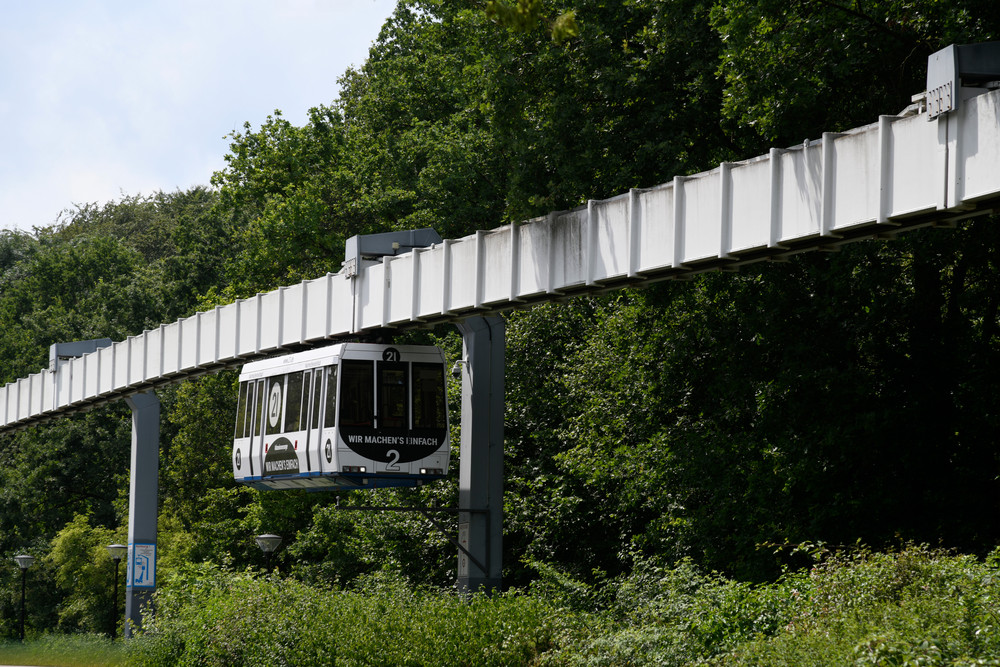
Accessible and Sustainable Mobility Since 1984
The H-Bahn at TU Dortmund stands out for its design, which is particularly space- and resource-efficient. Since the track runs on supports, ground sealing is kept to a minimum, and during operation, the train runs completely emission-free on-site thanks to its electric drive. In addition, the system uses a regenerative braking system that feeds braking energy directly back into the grid. An integrated backup system ensures continued operation in the event of system failures, so that no empty runs occur and no replacement vehicles are required (Ruhrgebiet-Industriekultur n.d.).
Financed by the Ruhr Action Program adopted in 1979 by the state government of North Rhine-Westphalia, the cost of the first 1.05-kilometer-long route with two vehicles amounted to 24 million DM. In 1993, the first extension was completed: the Eichlinghofen and S-Bahn Universität stations, designed to enhance mobility on campus, are 900 meters long. A further 1,212-meter extension to the nearby Technology Park was opened on December 19, 2003, with the total cost for this section amounting to 15.5 million euros (Horst 2024).
The H-Bahn is also socially sustainable, as it enables many people to travel from the “Campus Nord” to the “Campus Süd” without a car, which for many is simply not affordable. In this way, the H-Bahn helps reduce social inequalities. According to Google Maps, the H-Bahn is 9-14 minutes faster than various walking routes. Furthermore, it is significantly more accessible than the various walking routes, as it offers step-free access, whereas the walking routes all involve stairs or are significantly longer due to detours. With a 99% availability rate since it began operating, the H-Bahn is also very reliable (DSW21b 2024:16).
Although a ticket is required to use the H-Bahn, it is included in the semester ticket/Deutschlandticket. People with disabilities and their assistants may use the H-Bahn free of charge under certain conditions, such as holding a certificate for persons with severe disabilities ("Beiblatt mit Wertmarke") or having a registered assistant (sehnetz 2013). In the future, the H-Bahn network is scheduled to be extended from Campus North to the “Theodor-Fliedner-Heim” stop, connecting the university to the U42 light rail line (DSW21 2025). This is intended to improve the university’s connection to the city center.
It should be noted that, as of the time this text was written (July 2026), while information is available for people with disabilities, it is not explicitly provided for the H-Bahn, and the stations are not listed on DSW21’s own website as accessible or partially accessible (DSW21, n.d.).
References:
- Delkus, Horst (2024). Die H-Bahn in Dortmund verbindet als erstes vollautomatisches Verkehrsmittel zwei Uniflächen. Verfügbar unter: https://www.nordstadtblogger.de/die-h-bahn-in-dortmund-verbindet-als-erstes-vollautomatisches-verkehrsmittel-zwei-uniflaechen/ [abgerufen am 12.07.2026]
- DSW21 (2025): Vorbereitungen zum H-Bahn-Ausbau schreiten voran. Verfügbar unter https://www.bus-und-bahn.de/news-details/vorbereitungen-zum-h-bahn-ausbau-schreiten-voran [abgerufen am 12.07.2026].
- DSW21 (o. J): Barrierefreiheit. Verfügbar unter https://www.bus-und-bahn.de/barrierefreiheit [abgerufen am 12.07.2026].
- DSW21 (2024a): 40 Jahre H-Bahn in Dortmund. Verfügbar unter: https://www.bus-und-bahn.de/news-details/40-jahre-h-bahn-in-dortmund [abgerufen am 12.07.2026]
- DSW21 – Dortmunder Stadtwerke AG (2024b): Innovativ und klimafreundlich. einundzwanzig. S. 16–17. Verfügbar unter issuu.com/dsw21/docs/2024-21-2 [abgerufen am 12.07.2026].
- Ruhrgebiet-Industriekultur (o. D.): Die H-Bahn der TU Dortmund. Verfügbar unter: https://www.ruhrgebiet-industriekultur.de/h-bahn/ [abgerufen am 12.07.2026]
- sehnetz (2013): H-Bahn Dortmund. Seh-Netz e.V.. Verfügbar unter https://www.oepnv-info.de/freifahrt/informationen/nordrhein-westfalen/schwebebahnen-hochbahnen-nordrhein-westfalen/h-bahn-dortmund#more-386 [abgerufen am 12.07.2026].
Kontakt
References
Helling, Klaus. (2025): Die Verantwortung der Hochschulen für mehr Klimaschutz und Nachhaltigkeit. In: Kramer, Matthias. (Hrsg.): Systemische Nachhaltigkeit, SDG - Forschung, Konzepte, Lösungsansätze zur Nachhaltigkeit. Springer Fachmedien, Wiesbaden. S. 313–329.